
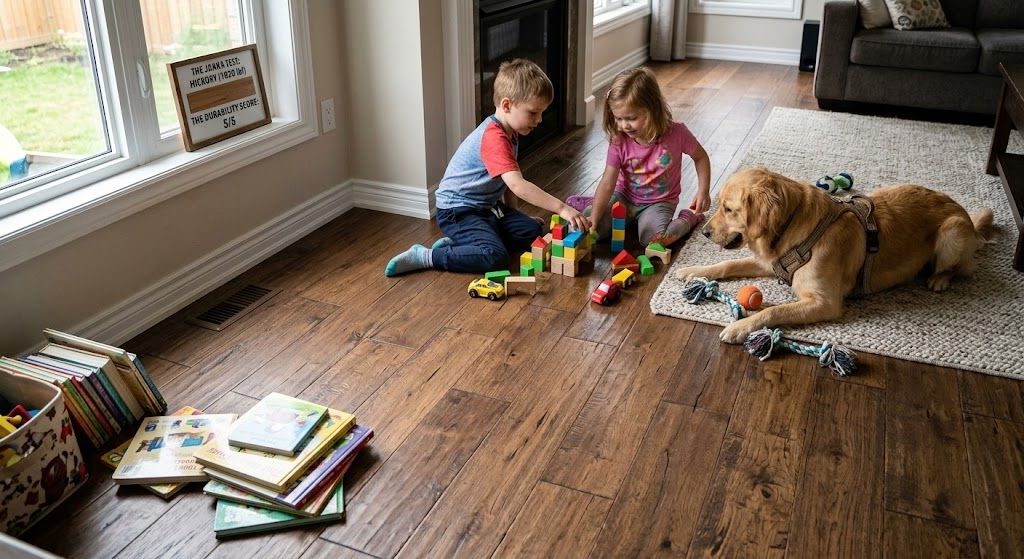
Your home is your sanctuary, but let's be honest, it’s also a high-traffic zone. Between kids (and their toys), pets (and their claws), and the daily hustle of running a household, your floors are on the front lines. Many people shy away from hardwood, fearing it will look ruined within a year.
The good news? You don’t have to sacrifice style for durability. You just need to choose a species that can "take a punch." Here is a guide to selecting hardwood flooring that will survive the chaos and still look stunning.
Before we dive into the species, you need to know about the Janka Hardness Scale. This is the ultimate tool for comparing wood durability. It measures how many pounds of force (lbf) it takes to embed a 0.444-inch steel ball halfway into the plank.
Lower number = softer wood (easily dented).
Higher number = harder wood (more resistant to dents).
Context: A moderate score is around 1,000 to 1,290 lbf (like Red Oak). Busy households should look for scores above 1,300 lbf for maximum durability.
When you know your floors are going to be worked, look past the softer woods like Cherry (950 Janka) or Pine (690-870 Janka). These heavy hitters are ready for a challenge:
Hickory is the undisputed champion of domestic hardwoods. It is incredibly dense and tough, making it almost impossible to dent. It also features beautiful, dramatic grain patterns that can hide existing imperfections remarkably well.
If you prefer a smoother, more subtle grain look, Hard Maple is a great choice. It is durable and clean, often used in gyms and bowling alleys for a reason. Note: Because its grain is tight, scratches might be slightly more visible than on textured woods.
This is the current darling of the design world, but it’s also highly durable. It has tight growth rings and excellent resistance to moisture (traditionally used in shipbuilding). Its distinct open grain is fantastic for hiding wear.
Wait, isn't bamboo a grass? Technically, yes, but when made into flooring, strand-woven bamboo (where fibers are fused under extreme heat and pressure) becomes one of the hardest materials available, often outranking even exotic hardwoods.
Choosing the right Janka rating is only half the battle. Your finish choices play a massive role in how "worn" your floor looks.
Busy households should run, not walk, away from high-gloss finishes. Shiny floors are like mirrors; they amplify every scratch, pet hair, and dust mote.
Instead, opt for a Matte or Low-Sheen finish. Matte surfaces absorb light and naturally diffuse visible imperfections, keeping your floor looking newer for longer.
This is a game-changer for parents and pet owners.
Distressed Floors: These planks are manufactured to look pre-aged, often featuring hand-scraping, saw marks, or wormholes.
Wire-Brushed Floors: A wire brush is used to pull the soft grain from the wood, creating a textured surface.
Why it works: If your dog scratches a wire-brushed floor, it just looks like part of the character. These textured finishes are designed to embrace and hide the natural "oops" moments of life.
| Species | Janka Rating | Key Benefit | Style Profile |
| Hickory | 1820 | Ultimate dent resistance | Rustic & Dramatic |
| White Oak | 1360 | Modern favorite, water-resistant | Versatile & Chic |
| Hard Maple | 1450 | Consistent and clean | Minimalist & bright |
| Strand Bamboo | 3000+ | Extreme durability | Contemporary & Eco |
Pro-Tip: If you have dogs, look into Red Oak with a wire-brushed texture. Red Oak (1290 Janka) has an incredibly prominent grain pattern that, combined with the brushing, hides a multitude of sins!