
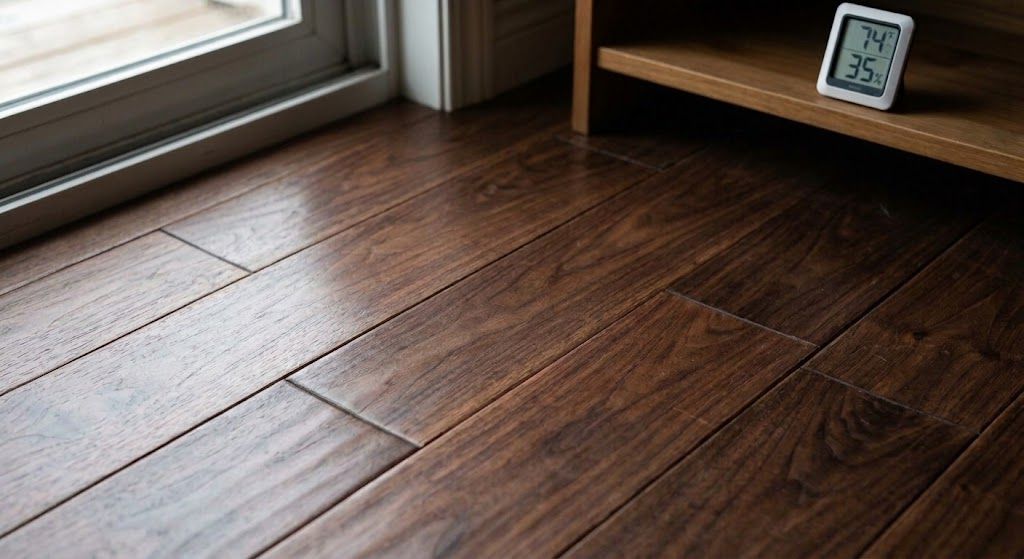
Hardwood flooring is a living, breathing part of your home. Unlike tile or laminate, wood is hygroscopic, meaning it constantly exchanges moisture with the air around it. When the air is wet, wood swells; when the air is bone-dry, wood shrinks.
If you’ve noticed new gaps between your planks this winter or edges that seem to be curling upward, you aren’t necessarily looking at a "bad install." You’re seeing your floor react to its environment.
To understand your floors, you have to understand how wood cells work. Think of a hardwood plank like a bundle of straws.
In Summer (High Humidity): The "straws" drink up moisture from the air and expand. If there isn't enough expansion space left at the walls, the boards push against each other, causing the edges to rise—a phenomenon known as cupping.
In Winter (Low Humidity): As your furnace kicks on and dries out the air, the wood loses moisture and "thins out." This is when you'll see gaps appear between the boards.
Technical Note: The ideal "sweet spot" for hardwood flooring is a consistent indoor relative humidity between 30% and 50%, with a temperature range of 15°C to 26°C.
Gaps are the most common complaint in colder climates. While small gaps (the thickness of a dime) are often considered a normal seasonal occurrence, large, permanent gaps can be a sign that the wood was not properly acclimated before installation.
The Fix: A whole-home humidifier can help stabilize the air and encourage the wood to expand back to its original state.
When the edges of a board are higher than its center, you have cupping. This is usually caused by a moisture imbalance—often high humidity in the room or a damp subfloor/basement underneath.
The Fix: Do not sand a cupped floor immediately. You must first eliminate the moisture source and allow the floor to dry. Sanding a cupped floor while it's still wet will result in "crowning" (the opposite problem) once it finally dries out.
This is when the center of the board is higher than the edges. It usually happens because the floor was sanded while it was cupped.
The Fix: This almost always requires professional sanding and refinishing once the moisture levels in the home have been stabilized for several months.
Managing humidity is the single most important thing you can do to ensure your hardwood lasts for generations.
Invest in a Hygrometer: These are inexpensive devices (usually under $20) that monitor your home’s humidity levels in real-time.
Use Your HVAC Wisely: Run your AC or a dehumidifier in the humid summer months, and ensure your humidifier is functioning during the dry winter.
Avoid Wet Mopping: Never use a dripping wet mop on hardwood. Use a damp microfiber cloth and a specialized wood cleaner to avoid adding unnecessary liquid to the "straws."
| Condition | Visual Sign | Primary Cause | Solution |
| Low Humidity | Gaps between planks | Dry winter air/Furnace | Humidifier |
| High Humidity | Cupping (Edges up) | High ambient moisture | Dehumidifier/AC |
| Moisture Imbalance | Crowning (Center up) | Sanding before drying | Professional refinish |